





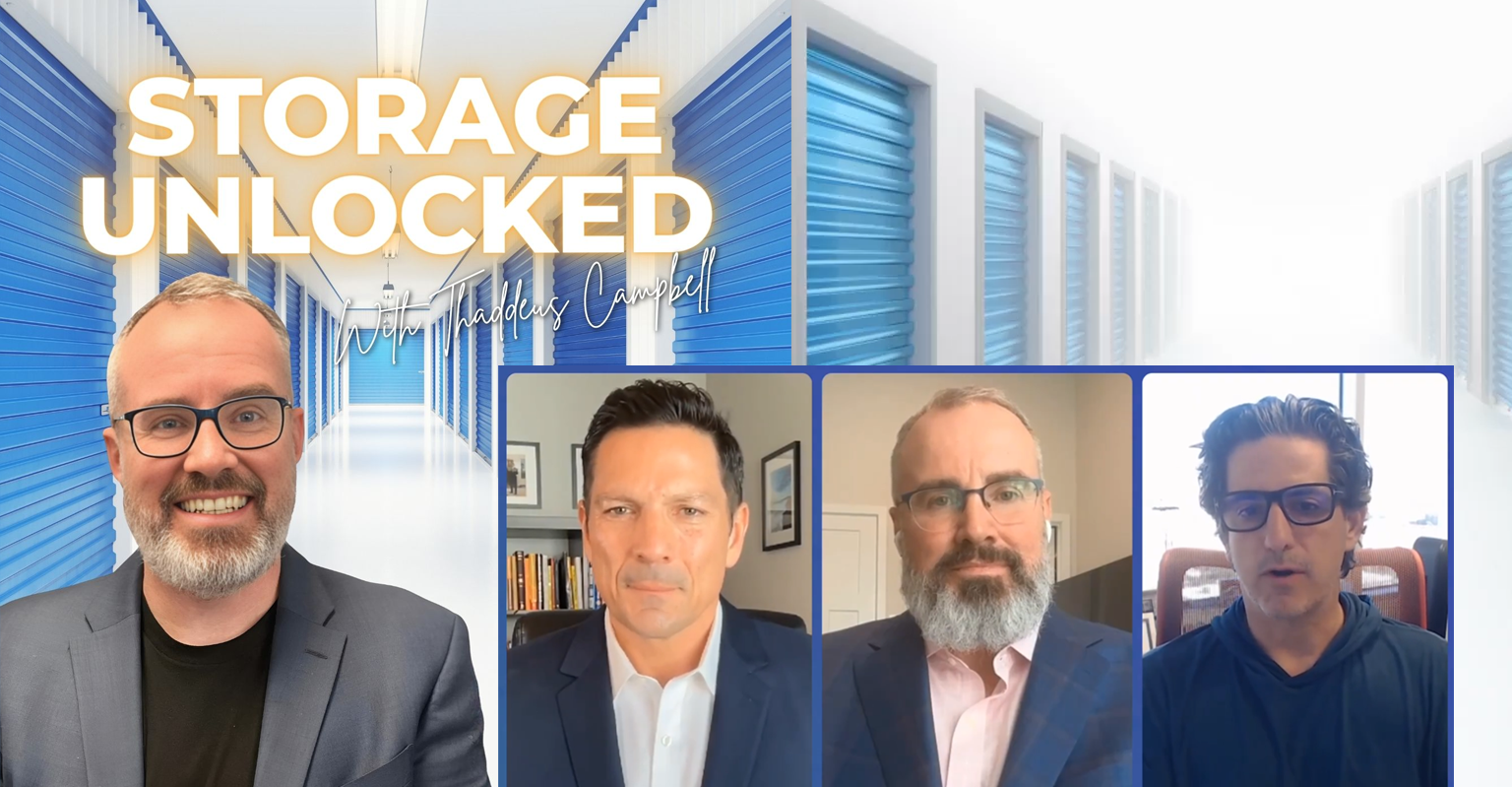
QuikStor owner Brett Henry did not set out to be a storage operator. He wanted to be a developer. What changed his mind was a spreadsheet full of missing money and a portfolio that nobody was paying attention to. Twenty-five years later, he runs one of the most closely managed portfolios in the industry and built the software to match. He sat down with Chris Berg and Thaddius Campbell of Storage Unlocked to talk through how he thinks about operations, data, and where the industry is headed.
What This Conversation Covers
- How Brett turned around a neglected 12-site portfolio early in his career
- The value-add playbook that drove a $245 million exit
- Why COVID made him rethink the software his operations team was running on
- What QuikStor is actually built to do and why it started as an internal tool
- How regional operators can compete with the REITs by knowing their data
01 — The Foundation Was Operations, Not Development.
Brett graduated college wanting to build things. His first job put him in the operations department of a company that had been in storage since 1974. He quickly noticed losses on the books. About half of the 12 managers were stealing: credit cards, checks, cash, over years. He documented everything and brought it to the owner.
That discovery led to a promotion and an unusual opportunity. He spent the next seven years running a neglected portfolio with strong locations and an absentee owner. The work was straightforward in principle: raise prices to reflect the market, fix deferred maintenance, improve the presentation of the facilities. In practice, it required consistent attention to why each site was underperforming and what it would take to close the gap.
“You had to ask why they were not raising prices, why they were not fixing roofs, why they were not making things nicer for customers and charging accordingly.” — Brett Henry / Owner, QuikStor
That portfolio eventually sold to Extra Space. The experience confirmed something important for Brett. He was not primarily a developer. He was an operations person. He liked being in the numbers, finding anomalies, and understanding what made a site work. That realization led directly to founding Trojan Storage with his friend and partner John Koudsi in 2007.
02 — The Value-Add Playbook Starts With the Rent Roll.
Trojan’s first portfolio was built on a simple premise. There were mom and pop operators charging 50 cents a foot in markets where Public Storage was getting $1.25. The whole focus in the industry at the time was occupancy. Owners would proudly report 95% occupancy without mentioning that they were getting half of what the market would support.
Brett and John set out to buy those properties, understand what was holding performance back, and fix it. The process started the same way every time: pull the entire rent roll into Excel, sort it, chart where the opportunity was, and compare it against what competitors were actually achieving.
“I still compile all of the rent rolls with my group and go through every line item every month. That has not changed in 25 years.” — Brett Henry / Owner, QuikStor
Sometimes the problem was visibility. A site on the 5 freeway in the San Fernando Valley had trees blocking the signage. They got a permit, paid $10,000 to cut the trees, and occupancy went from 75% to 85% in a month. Sometimes the problem was simpler than that. A Colorado Springs site they bought in 2013 had been charging the same rate for 10 years because the owner never learned how to raise prices in the software. It was 99% occupied and still leaving most of its potential revenue on the table.
The thesis was consistent: find assets where the gap between current performance and market performance was explainable and fixable. Buy right, operate well, and the value follows. That portfolio of 15 properties, assembled for around $75 million, sold in 2016 for $245 million.
03 — COVID Forced a Hard Look at How Operations Actually Ran.
By 2021, Brett had a large and well-run portfolio. He also had an operations team spending significant time working around the limitations of the software they were on. Managers were driving to the post office to mail lien letters. Reports took 45 minutes to load and sometimes failed entirely. Every page transition in the system added 30 seconds. People had developed so many workarounds that the workarounds had become the process.
COVID brought this into sharper focus. With everything slowing down, there was more time to see clearly what was not working. The conclusion Brett reached was that the operations team could not keep evolving the business without better tools. They were spending time managing software limitations instead of managing the business.
“If we could not control the development of the platform, we could not automate the delinquency process, centralize the call center, or centralize operations. We were stuck.” — Brett Henry / Owner, QuikStor
The original plan was to build something internal. QuikStor’s founder, Dennis Levitt, reached out at the right moment. Levitt was ready to take a smaller role and wanted to see the product move forward. The two sides spent time working out how to rebuild on a truly decentralized architecture, fast enough for live reporting, flexible enough to grow with where Brett wanted to take his operations.
Brett and his partner John have put millions of their own capital into the platform. No institutional money, no private equity.
04 — What QuikStor Is Built to Do.
All 50+ Trojan Storage sites now run on QuikStor. The core benefits Brett describes are speed, centralization, and the ability to build automation that actually reflects how operators work.
A practical example: when Trojan needs to update a lease for California compliance, the old process required going into each individual site database and making the change one at a time. QuikStor handles it at the corporate level in a single step. The same applies to discounts, bad-renter flags, and supervisor-level changes across the portfolio. Things that required coordinating 12 or 54 locations now happen once.
The reporting difference has had the biggest day-to-day impact. What used to take his revenue team four hours now takes six seconds. That time gets reinvested into the actual analysis.
Beyond operational efficiency, Brett sees QuikStor’s longer-term value in the correlations it can surface. How long do customers at a given site actually stay? At what point does a customer become less sensitive to rate increases? Does proximity, visit frequency, or housing type predict how a customer will respond to a change? Those are questions that require real data across a large portfolio to answer with any confidence.
“I know operators who want 4% a year and 97% occupancy. I know others who want all the growth upfront. Our goal is to give operators real data so they can make decisions the way they want to make them.” — Brett Henry / Owner, QuikStor
As more operators come onto the platform, those correlations become more meaningful for everyone on it.
05 — Regional Operators Can Compete. But They Need the Data to Do It.
Brett is not pessimistic about independent operators competing with the REITs, but he is clear about what it requires. You need to know your customer acquisition costs. You need to know where people are dropping out of your rental funnel and why. You need managers who can operate efficiently, and customers who can pay and rent without friction.
His broader view is that the consolidation of the last several years has not produced the outcomes people expected. Large portfolios managed by operators whose primary interest is in the assets they own, not the assets they manage, tend to show it over time. Regional operators who know their markets, understand their customer base, and manage their numbers closely have real advantages. They are just harder to realize without the right tools.
The rent control conversation in California is a version of the same problem. Brett’s read is that pricing practices that moved customers in at $60 and raised them to $400 over time contributed to the regulatory environment that followed. The industry would be better served by operators competing on quality and service, backed by data that supports smart pricing decisions rather than reactive ones.
“If you do not run your properties every day and do not have the data and the ability to act on it, then maybe third-party management makes sense. But I do not think that is the right answer for most operators.” — Brett Henry / Owner, QuikStor
QuikStor is fast, reliable, and owned by veteran operators. Book a demo today and see if QMS is the right fit for your operation.