





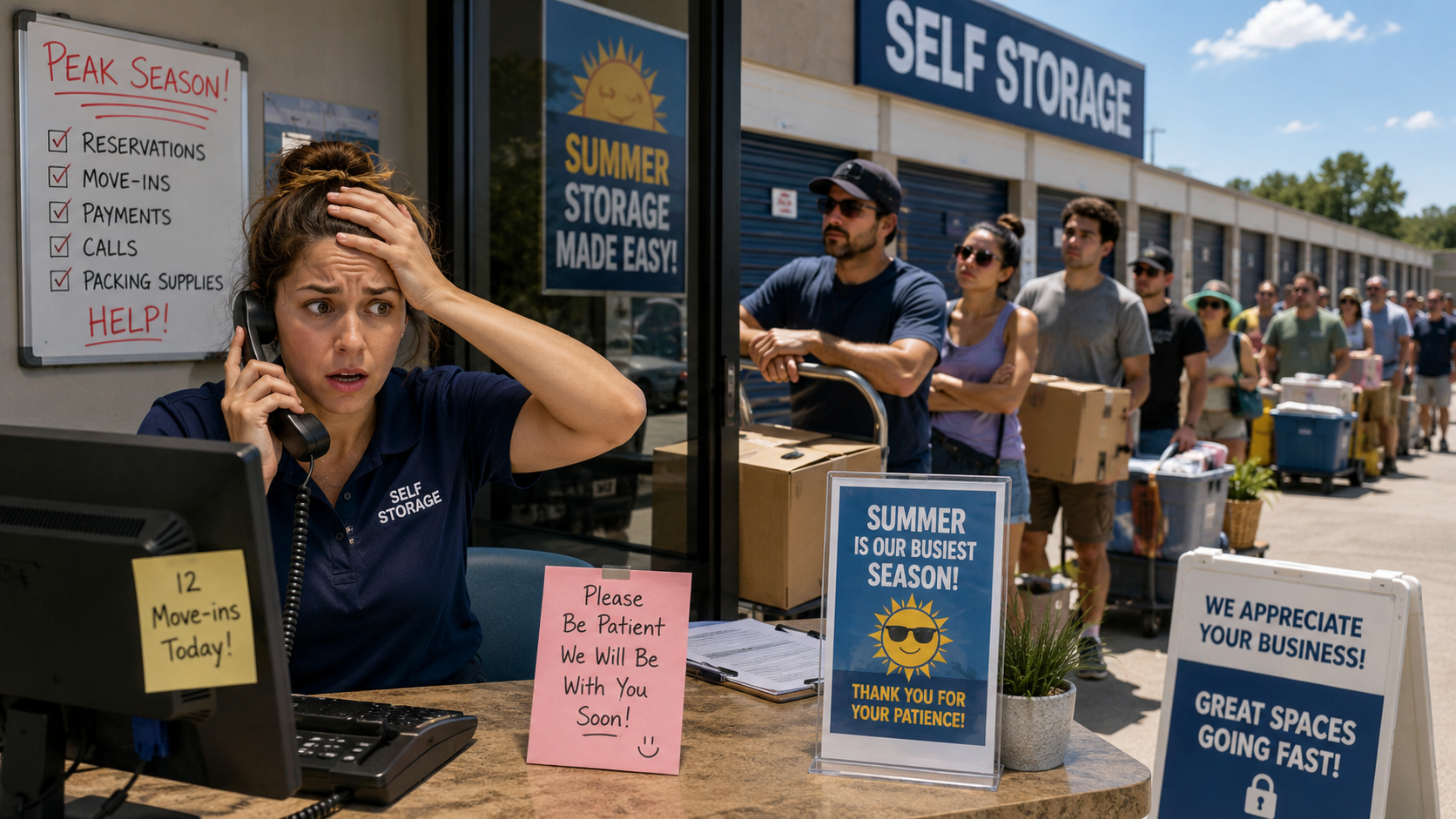
Summer is here. And if you’re just now thinking about whether your operation is ready for it, you’re not alone. The operators who sail through peak season aren’t the ones who react the fastest. They’re the ones who did the work before the rush hit.
This year the stakes are a little higher. According to Yardi Matrix’s 2026 State of Self-Storage report, occupancy varies dramatically by market, with Seattle and and Baltimore averaging above 90 percent while Florida, Mississippi, and parts of the Midwest sitting below 80 percent. That kind of disparity means operators can no longer rely on broad market tailwinds to carry them through summers. Factors like local conditions, pricing discipline, and operational efficiency are what separate the operators who have their best season from the ones who just survive it.
Here’s the checklist that gets you there.
1. Audit your online rental experience. As a tenant.
Customer acquisition is the top priority for 75% of operators in 2026. Where do the majority of move-ins start nowadays? Online. Walk through your own rental flow on a mobile device as if you were a first-time tenant. How many steps did it take? Where does it slow down or break? Is pricing current and accurately displayed?
A clunky experience during peak season doesn’t just frustrate prospects. It sends them to competitors down the street. This is one of the highest-return fixes an operator can make in an hour.
2. Get your pricing positioned before demand peaks.
This is the single most important revenue decision you make right now. With the average self-storage tenant now staying 18 to 19 months — roughly double pre-pandemic averages — pricing discipline is how operators drive revenue in a lower-turnover market. You just can’t rely on move-in volume alone.
Pull your current street rates against local market competitors by unit type. From there, identify where you have pricing room before demand peaks and act now. Don’t forget to tighten discounts on high-demand unit sizes, and if you have vacancies in slower categories, consider a short-term promotional push now rather than react to empty units in July.
Everyone loves the idea of a deal. Catchy, limited-time incentives can attract those seeking storage space for their belongings during the warmer months.
3. Review your rate increase strategy for existing tenants.
Conversations around rent regulations have continued as markets pass new legislation that focus on consumer protection in self-storage operations. California’s SB709, for instance, passed in October 2025 and introduces strict, transparent pricing disclosures for all self-storage rental agreements starting on and after Jan. 1, 2026. What’s permissible in California may differ from Texas, and getting this wrong is an expensive mistake.
Beyond compliance, think about sequencing. Rate increases land better when they’re timed to value additions. Summer is a natural window for this if you have facility improvements on the horizon.
4. Stress-test your delinquency workflow.
Delinquency rates have stayed below pre-pandemic averages, which is the good news. The bad news is that tenant turnover increases in summer, and any cracks in your delinquency process will get exposed fast when volume picks up.
Get ahead of it now. Confirm your escalation workflow is fully documented and automated where possible. Every stage — first notice, second notice, lien letter, gate restriction, auction placement — should trigger automatically without someone on your team remembering to do so. If any part in your process requires a manual step, that is a seasonal liability worth looking into.
5. Audit your software and integrations across every site.
With volume already picking up, now is exactly the right time to find out what’s not working efficiently before it becomes a bigger problem. Operators who closely track performance will have an easier time navigating shifts in the market. And, let’s face it. Nothing disrupts that more than a gate integration that fails silently or a billing system that drops autopay charges around the first of the month.
Check gate integrations across all sites. Confirm autopay is running cleanly. Review any manual workarounds your team has built to manage your software limitations. If your reporting takes more than a few minutes to generate across your entire portfolio, that is time your team is losing every single week.
Peak season isn’t the time to discover your operating platform can’t keep up.
6. Review your tenant communication templates.
Summer brings more of everything. Higher move-in volume, more rate increase notices, and more delinquency follow-up. All of that communication needs to go out on time, accurately, and in a voice that reflects your facility’s brand.
Pull your current email and SMS templates. Update any seasonal language. Make sure move-in confirmations, rate increase notices, and payment reminders are pre-configured and ready to send automatically. A message that is late or with incorrect information creates tenant friction at the worst possible time.
7. Prepare your team for the pace.
Digital-first experiences, flexible leasing, and a greater emphasis on operational efficiency are defining how operators compete in 2026. For teams running lean, summer is when that strategy gets tested.
Make sure every team member knows the escalation path for common issues. Confirm that any seasonal staff are fully onboarded now if they aren’t already. Identify the highest-risk manual processes in your operation and eliminate or automate them before they become a serious burden under pressure.
8. Set your reporting cadence now.
You want more visibility during peak season, not less. Define which reports you pull daily versus weekly, across which sites, and who owns them. Occupancy by unit type, delinquency rate, billing performance, and move-in pace should be on someone’s radar every day through August.
For any reports that require more than a few minutes or logging into multiple systems is a workflow problem worth solving this week. Not a frustration you want to manage while you team is at full capacity.
9. Walk your facilities before the rush hits.
The adage is true. First impressions do in fact matter! During peak season, more eyes are on your properties than ever. Prospective tenants are driving by, are walking the lot, and are making split-second decisions about whether they feel safe leaving their belongings there or not. A facility that looks well-maintained and well-lit signals professionalism and security before a single conversation happens.
Physically walk every location with fresh eyes. Check exterior lighting. Burned out bulbs in corridors, parking lots, and entry points are a security concern. Also inspect fencing, gate hardware, and access control for anything that looks worn, damaged, or out of place. Look at signage, landscaping, and common areas the way a first-time visitor would. Drive by your facility from every angle and see what you see (or don’t see). Address anything that signals neglect.
The best marketing in the world can’t overcome a facility that makes a tenant feel uneasy the moment they pull into the parking lot.
The operators who have their best summers act now
Every item on this checklist is still actionable. But the window to get ahead of it is mere weeks, not months. The operators running the smoothest operations right now didn’t wait for the rush to remind them.
If any of these items point to gaps in your current FMS, we’re here for that conversation when you’re ready.